
It’s one of the most common questions we hear from builders and homeowners: should we go with steel stairs or stick with timber? Both are viable options but they suit different projects, different budgets and different long-term expectations. Here’s an honest comparison to help you decide.
Steel wins.
Steel has a significantly higher strength to weight ratio than timber. A steel stringer staircase can handle far greater loads making it the only practical choice for industrial and commercial applications, mezzanine access, and any situation where heavy ongoing foot traffic is expected.
For residential builds, a well engineered timber staircase can handle normal household loads comfortably. But if you’re building a dual occupancy, a steeper rise situation, or a stair that may double as access for tradespeople carrying equipment steel handles it without question.
Steel wins with the right finish.
Properly primed, painted or galvanised steel stairs will outlast timber in almost every situation. Steel doesn’t warp, crack, split or swell with moisture. It’s not susceptible to termite damage. In outdoor or semi-exposed situations coastal properties, warehouse access, external fire escapes steel is far more durable than timber.
Galvanised steel outdoor stairs, in particular, are extremely low maintenance and can last 40–50+ years with minimal upkeep.
Timber can be very long-lasting indoors in stable conditions, but in Sydney’s climate particularly in coastal, semi-exposed or high-humidity environments it requires significantly more ongoing maintenance.
Steel wins for low maintenance builds.
Steel stairs require very little maintenance. An internal staircase with a good quality paint finish may need a touch-up every 10–15 years. External galvanised or powder coated stairs are essentially maintenance free for the first 20+ years.
Timber stairs require regular checking, sealing, oiling or repainting and any damage from moisture, impact or termites needs prompt attention to prevent structural deterioration.
Steel wins on structural flexibility; timber wins on tactile warmth.
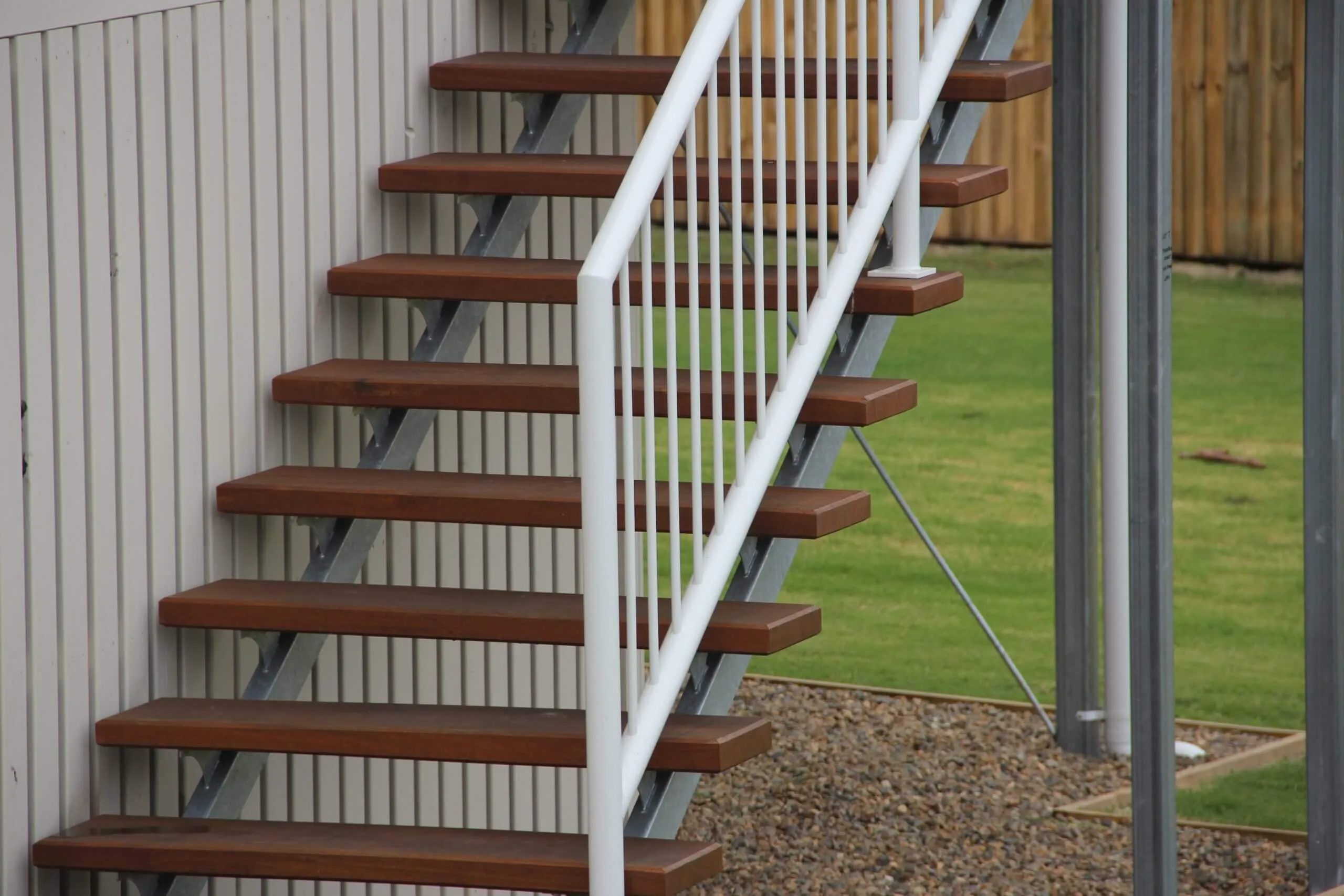
Steel gives you far more design flexibility from a structural standpoint. Mono stringer floating stairs, open riser designs, cantilevered treads and architectural feature staircases are all easier to achieve cleanly in steel. The slim profile of a steel stringer creates a lighter, more contemporary visual that timber simply can’t replicate.
Timber brings warmth and a natural aesthetic that many homeowners prefer for traditional or coastal Australian home styles. The good news is that steel and timber are often combined a steel stringer frame with timber treads is one of the most popular residential staircase options in Sydney, giving you structural performance and a warm finish.
Timber is typically cheaper upfront; steel offers better long term value.
For a basic residential staircase, timber is generally less expensive to supply and install. A straightforward timber stair can come in at $3,000–$6,000 installed, while a comparable steel stringer stair sits closer to $4,000–$8,000.
However, when you factor in maintenance costs, lifespan and the frequency of replacement or repair steel’s long-term cost is often lower. For commercial and industrial applications, steel isn’t just a cost preference it’s a necessity.
Both comply but steel is simpler for engineers.
Both steel and timber staircases can be designed to meet the National Construction Code (NCC). However, for commercial, industrial and multi-residential applications, structural engineers typically specify steel it’s easier to document, certify and inspect. Certifiers and building inspectors rarely raise concerns about properly engineered steel staircases.
Factor | Steel | Timber |
|---|---|---|
Structural strength |  Superior Superior |  Adequate for residential Adequate for residential |
Durability / lifespan | 40–50+ years | 15–30 years with maintenance |
Maintenance | Minimal |  Regular upkeep required Regular upkeep required |
Design flexibility | Modern & architectural | Traditional & warm |
Upfront cost | Moderate to high | Lower for basic designs |
Long-term value | Lower total cost of ownership | Higher maintenance costs |
Commercial / industrial suitability | Yes | Not recommended |
Bottom line: For commercial, industrial and outdoor applications steel is always the right choice. For residential builds, it comes down to your design intent, budget and how much maintenance you’re willing to commit to. Many Sydney builders now default to steel stringers with timber treads as the best of both worlds.
Sydney Structural Steel fabricates and installs custom steel staircases including steel stringer stairs with timber or steel treads for builders, carpenters and homeowners across Sydney and NSW.
Call [+61] 296154777 or visit sydneystructuralsteel.com.au/